Philips 4400 vs 5500: Which LatteGo Machine? (November 2026)
Pick the Philips 5500 if you want the widest drink menu and four saved profiles; pick the 4400 if 12 presets and two profiles cover your usual order. The 5500 wins overall on flexibility, but the gap matters most for households that make several different milk drinks.
On this page (8 sections)
- Philips 4400 vs 5500: the two machines side by side
- Presets decide the choice for most households
- Profiles matter when more than one person uses the machine
- The LatteGo milk system works the same on both
- Brew speed, noise and water capacity are shared
- Size and counter fit: measure before you order
- Which should you buy: the 5500 or the 4400?
- The verdict: flexibility vs simplicity
Pick the Philips 5500 if you want the widest drink menu and four saved profiles; pick the 4400 if 12 presets and two profiles cover your usual order. In this Philips 4400 vs 5500 comparison, the 5500 wins overall on flexibility, while the 4400 is the better fit for a simple routine.
Both machines share the same LatteGo milk system, the same 3-second QuickStart and the same 1.8-liter water tank. The real choice comes down to how many drinks you make and how many people save their own settings.
The 5500 carries a score of 8.7 and the 4400 a score of 8. That small gap reflects the preset and profile difference, not a gap in build quality.
Our score weighs specs, features and buyer feedback against what you're shopping for.
Philips 4400 vs 5500: the two machines side by side
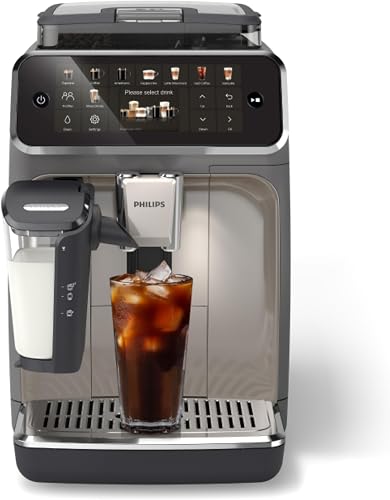
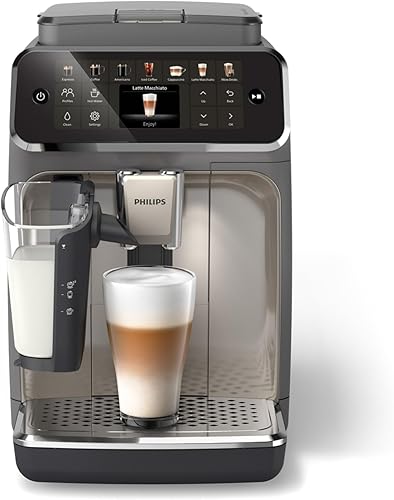
The 5500 adds 8 presets, 2 more profiles and a touchscreen; the 4400 keeps the same core drinks at a lower price tier. Everything else that matters to daily use is shared.
| Feature | Philips 5500 LatteGo | Philips 4400 LatteGo |
|---|---|---|
| Drink presets | 20 | 12 |
| Saved profiles | Up to 4 | Up to 2 |
| Display | Color touchscreen | Color display with buttons |
| Milk system | LatteGo, 3 parts | LatteGo, 3 parts |
| Milk cleanup | Rinse in about 10 seconds | Rinse in about 10 seconds |
| QuickStart | Ready in 3 seconds | Ready in 3 seconds |
| Water capacity | 1.8 liters | 1.8 liters |
| Pressure | 15 bar | 15 bar |
| AquaClean | Up to 5,000 cups without descaling | Up to 5,000 cups without descaling |
| Model number | EP5544/94 | EP4444/90 |
The core menu is identical on paper. Espresso, coffee, latte, cappuccino and iced coffee appear on both, so a plain latte or an iced coffee tastes the same from either machine.
The 5500's extra presets sit on top of that core list. Philips doesn't name each of the 20 drinks in the data, so treat the added presets as more choices rather than a set you can count one by one.
How the controls differ in daily use
The 5500 uses a color touchscreen, which means tapping through drinks and settings on screen. The 4400 uses a color display with buttons, so you press to move between options.
Neither control style changes what comes out of the spout. The difference is how quickly you reach a less-used drink and how easily a guest can find their order without instructions.
Presets decide the choice for most households
Choose the 5500 if your household orders more than four different drinks; choose the 4400 if you cycle through the same few. Presets are the main reason to pay more for the 5500.
The 5500 lists 20 presets and the 4400 lists 12. Both cover hot drinks from espresso and coffee to lattes and cappuccinos, plus iced coffee and hot water.
Those 8 extra presets on the 5500 are where the money goes. They matter if you like milk-heavy drinks beyond the standard latte and cappuccino, or if you want more variety without adjusting settings by hand.
The rest of the core drinks on either list include espresso, latte, macchiato and cappuccino territory, so the base recipes you order most often are never the thing you lose on the 4400. What you lose is breadth, not the drinks themselves.
When 12 presets are enough
Twelve presets cover the drinks most people make in a week: espresso, coffee, latte, cappuccino, iced coffee and hot water. If that list already matches your routine, the 4400's shorter menu won't feel limiting.
The 4400 still lets you adjust strength, volume and milk level on each drink. So the menu is shorter, but the drinks aren't locked to one recipe.
Our Philips 5500 review walks through how the full preset list works in a household, if you want the longer menu but aren't sure you'll use it.
When the 20-preset menu earns its keep
The 5500 suits a home where people order different milk drinks through the week. A flat white fan, a cappuccino drinker and someone who wants an iced coffee can each find a preset without fiddling.
More presets also help when you host. Guests can pick a drink from the screen instead of asking you to adjust milk froth by hand.
If your drink order rarely changes, the extra presets add choice you won't use. That's the case for the 4400.
Profiles matter when more than one person uses the machine
The 5500 saves up to 4 profiles and the 4400 saves up to 2, so the 5500 is the better fit for a busy shared kitchen. A profile keeps your strength, volume and milk settings ready for next time.
This is the second clear difference between the machines. Philips builds both to grind, tamp and brew at the push of a button, then remember your settings.
On the 5500, up to 4 people can each keep a profile. On the 4400, up to 2 can.
For a couple, the 4400's two profiles cover both people.
For a family of four or a home where guests make drinks often, the 5500's extra profiles save the "who changed my settings" problem. That alone can justify the step up.
It's worth knowing what a profile actually holds so you can judge whether you need more than two. Each saved profile stores your strength, volume and milk preferences, so it isn't just a shortcut to a drink name.
It's the recipe you built for yourself, returned to in one touch. If two people in your home take their cappuccino at different strengths and milk levels, the 4400 can hold both recipes without anyone re-entering settings each morning.
Add a third regular drinker or a frequent guest with a different order and the 4400 runs out of slots, while the 5500 still has room.
The LatteGo milk system works the same on both
Milk frothing and cleanup are identical on the two machines, so the 4400 and 5500 tie on the daily milk routine. LatteGo is the reason many people choose this line in the first place.
Philips describes LatteGo as 3 parts with no internal tubes or hidden compartments. That design means you rinse the carafe in about 10 seconds, or put the parts in the dishwasher.
The milk system automatically steams, foams and froths milk to build lattes and cappuccinos. You set the milk level and froth on the display, and the machine does the rest.
Because both machines use the same system, milk cleanup doesn't decide the choice. If you make a latte every morning, either machine gives you the same short rinse afterward.
The lack of internal tubes is the detail that matters most over time. Milk travels through the removable carafe rather than sitting inside the machine, so there's no hidden path to scrub.
Three parts mean three things to separate and rinse, and the dishwasher-safe design means you can skip hand-washing on a busy night. A proprietary milk system this simple is also why the line appeals to people stepping up from a manual frother.
If you want to compare this milk system against a rival brand's, our De'Longhi vs Philips espresso machine breakdown covers how the two approaches differ in cleaning and milk handling.
Brew speed, noise and water capacity are shared
Both machines are ready to brew in 3 seconds and use the same 1.8-liter tank, so speed and capacity don't separate them. The choice stays with presets and profiles.
Philips uses QuickStart on both models to reach brew temperature in 3 seconds. That's useful in the morning when you want a coffee before you've fully woken up.
Both also carry SilentBrew sound shielding and quiet grinding, which Philips says makes them 40% quieter than earlier models. If your kitchen is open to a bedroom or a home office, that matters.
The 1.8-liter tank holds enough water for a run of drinks before a refill. Both machines share that capacity, so a large household won't gain tank size by choosing the 5500.
The 15-bar pump and built-in grinder are also common to both. So is the AquaClean filter, which Philips says can carry you up to 5,000 cups without descaling.
The grinder takes whole beans on both models, and the 4400 also lists ground coffee as an input option alongside beans. If you keep a bag of decaf grounds for evening drinks, that flexibility is worth knowing about before you choose.
The metal filter and 15-bar pump are the same hardware story on the 5500.
What Quiet Mark certification means for a shared home
Both machines carry Quiet Mark certification for SilentBrew, so the noise claim isn't just marketing language. A grinder that runs quietly matters in an apartment, a small house or any kitchen next to a sleeping room.
The 40% quieter figure is measured against earlier Philips models. It tells you the machine is quieter than the generation before it, not that it's silent.
Expect a normal kitchen-appliance hum during grinding rather than a coffee-shop roar.
Size and counter fit: measure before you order
The 4400 is listed as wider and shorter and the 5500 as narrower and taller, so check your counter and cabinet clearance. The cabinet shapes differ enough to matter under low shelves.
The 5500 measures 9.69 in deep, 14.61 in wide and 17.05 in high. The 4400 measures 9.68 in deep, 17.04 in wide and 14.6 in high.
That means the 4400 is about 2.4 inches wider but about 2.4 inches shorter. The 5500 is the taller, narrower machine.
Under a low cabinet, the 4400's shorter height gives more clearance. In a narrow gap between counters, the 5500's slimmer width fits more easily.
Check the height first if your cabinets sit low
Height is the measurement people forget. A machine that's too tall won't slide under an upper cabinet, and you'll be stuck brewing on the open counter.
Measure from the counter to the bottom of the cabinet, then leave a little room to lift the water tank and reach the bean hopper. The 4400's lower height gives you more headroom for that.
Check the width if your counter is tight
Width matters when the machine sits between a wall and a fridge. The 5500's narrower cabinet leaves more clearance on either side.
Don't forget the cup clearance under the spout and the room to swing the milk carafe in and out. Both need space in front for filling and rinsing.
Which should you buy: the 5500 or the 4400?
Buy the Philips 5500 if several people share the machine or you want a longer drink menu; buy the 4400 if two profiles and 12 presets match your routine. That's the whole Philips 4400 vs 5500 decision in one line.
The 5500 is the better machine overall. Its 20 presets and 4 profiles give a shared kitchen more room to keep everyone's order saved, and the touchscreen makes the longer menu easier to move through.
The 4400 is the smarter buy for a simpler home. It brews the same core drinks, uses the same LatteGo carafe and offers the same 3-second start, so a single-coffee drinker gives up little.
Pick the 5500 if...
You make several different milk drinks and more than two people use the machine. The 4 profiles and 20 presets keep each order saved without resetting strength or milk settings.
You also get the touchscreen and the slimmer cabinet. If your counter is narrow rather than low, that width advantage helps.
Pick the 4400 if...
You mostly make one or two drinks and one or two people use the machine. The 12 presets include espresso, latte, cappuccino and iced coffee, which covers a normal week.
The shorter cabinet also helps under low upper cabinets. You save money and still get LatteGo cleanup and fast brewing.
If you're still weighing the wider Philips range, our guide to the best Philips espresso machines from 1200 to 5500 shows where each model sits. And if you're deciding whether the 5500 is a step up from a smaller model, the Philips 3300 vs 5500 comparison covers that jump.
| Product | Best for | Presets | Saved profiles | Interface | Our score |
|---|---|---|---|---|---|
| Philips 5500 LatteGo | varied drink menus | 20 | Up to 4 | Color touchscreen | 8.7 |
| Philips 4400 LatteGo | simple routines | 12 | Up to 2 | Color display with buttons | 8.0 |
The verdict: flexibility vs simplicity
The Philips 5500 is the pick for most shared kitchens; the 4400 is the better value for a simple routine. Neither machine wins on milk cleanup or brew speed, so presets and profiles carry the decision.
Go with the 5500 when the drink menu and saved profiles will get used. Go with the 4400 when 12 presets and 2 profiles already fit how you make coffee, and put the savings toward beans.
The short version: the 5500 is the same coffee hardware with a bigger control layer on top. The 8 extra presets, 2 extra profiles and touchscreen are the only meaningful differences, and everything from LatteGo to the AquaClean filter carries over unchanged.
Decide how many distinct drinks and drinkers your kitchen really has, and the right model follows from that.
Frequently asked questions
What is the main difference between the Philips 4400 and 5500?
The 5500 has 20 presets, up to 4 saved profiles and a color touchscreen. The 4400 has 12 presets, up to 2 profiles and a color display with buttons.
The LatteGo milk system and 3-second QuickStart are on both.
How many coffee profiles can each machine save?
The 5500 saves up to 4 profiles and the 4400 saves up to 2. A profile stores your strength, volume and milk settings, so more profiles help when several people in one home want different drinks.
Is the Philips 5500 worth it over the 4400?
For a household making several milk drinks at different settings, yes. The extra presets and profiles keep everyone's order saved.
If you mostly make one or two drinks, the 4400 covers the same core menu.
Do both machines brew iced coffee?
Yes. Both list iced coffee among their presets, along with espresso, coffee, latte and cappuccino.
The 5500 simply adds more preset options on top of those core drinks.